
Home » 2026
Yearly Archives: 2026
Author Box

Sandra Johnston
PSYCHEDELIC MUSHROOM GUMMIES: WHAT YOU SHOULD KNOW BEFORE YOUR FIRST ONE
Psychedelic mushroom gummies have become the fastest-growing product category in the psilocybin market, driven largely by people who would never have considered dried mushrooms. The format is familiar, the dosing is clear, and taking one feels closer to eating candy than embarking on a psychedelic journey.
But that accessibility comes with a responsibility to understand what you’re consuming.
Order online at: – https://mycrologi.co/
They’re Not Regular Gummies With a Twist
The most common misconception is that psychedelic mushroom gummies are a mild, casual product. Some are — microdose gummies at 100mg per piece are designed for subtle, sub-perceptual effects. But full-dose gummies at 500mg, 1g, or 2g per piece are powerful products that demand the same respect as any other form of psilocybin.
The gummy format makes it easy to forget that distinction. A small, sweet, fruit-flavored square doesn’t look intimidating — which is exactly why reading the label before eating one is non-negotiable.
How They’re Made
Quality psychedelic mushroom gummies start with psilocybin extract or finely ground mushroom powder blended into the gummy base during manufacturing. The best producers use homogenization techniques to distribute psilocybin evenly, ensuring every gummy in the package contains the same dose.
Cheaper manufacturers skip this step, resulting in inconsistency that’s annoying at microdose levels and potentially overwhelming at full doses.
The base ingredients matter too. Premium gummies use pectin instead of gelatin for a vegan-friendly formula, natural fruit flavors, and plant-derived colors.
Choosing the Right Dose
Microdose (50mg–250mg per gummy): For regular use, often every third day. Effects are sub-perceptual — improved mood, sharper focus, a slight lift in creative energy without psychedelic sensations.
Moderate dose (500mg–1g per gummy): Produces noticeable effects — heightened senses, emotional openness, mild visual enhancement. Set aside a few hours in a comfortable environment.
Strong dose (1.5g+ per gummy): Full psychedelic territory. Deep introspection, visual and auditory changes, potential ego softening. For experienced users who understand set and setting.
If you’re unsure, start at the lower end. You can always take more next time.
Onset and Duration
Gummies typically take 30 to 60 minutes to take effect, depending on whether you’ve eaten recently. A moderate to strong dose lasts four to six hours, with the peak around the two-hour mark. Microdoses don’t produce a perceptible peak — effects are steady and subtle throughout the day.
What to Look for When Buying
Four things separate trustworthy products from questionable ones. Clearly labeled psilocybin content per piece, not just per package. A named mushroom strain. A clean ingredient list without unnecessary fillers. And a brand with enough track record that you can find reviews from real customers.
Skip any product that’s vague about dosing, uses generic packaging, or doesn’t identify the strain. Those details exist to help you have a controlled, positive experience — and any brand that omits them isn’t prioritizing yours.
UNLOCKING RAW POTENCY: UNDERSTANDING THCA IN THE 2026 CANNABIS MARKET
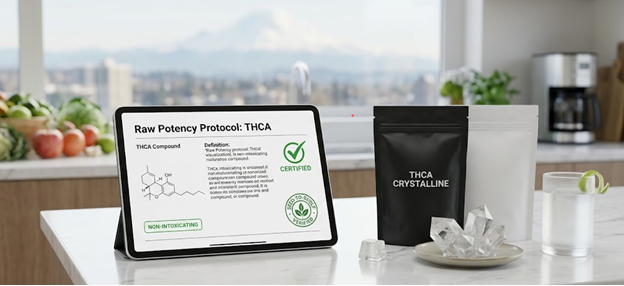
As of March 2026, the American cannabis industry has transitioned from a focus on simple intoxication to a sophisticated era of targeted molecular wellness. While Delta-9 THC remains the primary recognized compound, a significant shift is occurring toward its acidic precursor: THCA King (Tetrahydrocannabinolic Acid). Often misunderstood, THCA is the compound that exists naturally in the living, raw cannabis plant. In 2026, we understand that its potential is realized precisely because it is not intoxicating in its natural, acidic state. For consumers seeking precise physiological support without cognitive alteration, THCA has become the cornerstone of advanced raw cannabis protocols.
The Science of THCA: The Molecule and Decarboxylation
The primary characteristic of THCA is its structure. Critically, it possesses an extra carboxyl group (COOH) that Delta-9 THC does not.
- Non-Intoxicating by Design: This extra carboxyl group makes the THCA molecule physically larger, preventing it from binding effectively with the CB1 receptors in the human brain that produce the psychoactive “high.” This foundational difference allows THCA to be consumed for its independent wellness benefits without inducing euphoria.
- The Transformation into THC: The defining complexity of THCA lies in its instability. When the compound is exposed to heat (vaping, smoking, or standard combustion), the extra carboxyl group is dropped. This instant reaction, known as decarboxylation, transforms the stable, non-intoxicating THCA into the smaller, intoxicating Delta 9 THC molecule.
Targeted Physiological Support and Wellness Protocols
By 2026, extensive clinical research has validated several key pathways where THCA excels, often working through non-CB1 receptor systems such as TRPV1 and GPR55.
- Potent Anti-Inflammatory: Research in 2026 consistently highlights THCA as an exceptional anti-inflammatory agent. By inhibiting certain inflammatory pathways and enzymes (such as COX-1 and COX-2) without systemic intoxication, it has become a preferred protocol for managing chronic localized physical discomfort.
- Neuroprotective and Anti-Emetic Support: Studies from the early 2020s have matured into verified protocols, suggesting THCA is an emerging tool in neuroprotection, showing promise in mitigating neuroinflammation. Additionally, THCA has been found to be equally effective as THC in managing nausea, often requiring a lower dose and bypassing the psychoactive effect which many sensitive individuals prefer to avoid.
Safety Standards, Compliance, and Lab Verification in 2026
For consumers navigating the 2026 THCA market, safety and regulatory transparency are non-negotiable. With the industry moving away from converted synthetic cannabinoids, naturally extracted THCA must be validated by a comprehensive Certificate of Analysis (COA). A verified THCA product must always provide third-party lab testing confirming the complete absence of pesticides, heavy metals, or residual solvents.
In 2026, the gold standard for therapeutic THCA is “Crystalline.” This isolate, often achieving 98%+ purity, represents the peak of molecular standardization. These pristine, geometric structures ensure users are accessing the specific benefits of the acidic precursor without interference from other minor cannabinoids, allowing for highly predictable dosing in structured wellness routines.
Preserving the Acidic State: Optimal Methods and Storage
To utilize THCA effectively, proper delivery and storage are crucial.
- Cold Extraction Methods: Because heat immediately decarboxylates the molecule, raw consumption is essential. Many 2026 wellness advocates utilize fresh, raw cannabis leaves for juicing, accessing the full plant matrix. For standardized dosing, pure THCA crystalline is often suspended in an MCT oil carrier, creating a tincture that can be taken sublingually.
- Optimal Storage Protocols: Oxygen, heat, and light are the primary threats to THCA stability. To prevent the acidic matrix from degrading and converting into unintended THC, non-intoxicating THCA products must be stored in opaque, airtight containers. For maximum longevity in 2026, consistent cold storage (refrigeration) is required, ensuring the complex chemical profile remains potent and therapeutically relevant.